Book Reviews
A Chess Parent's Christmas Gift Guide: Books for Young Players
Buying a chess book for a child is harder than it looks. Shop shelves are not arranged by playing strength, and a title with a friendly cover can still be full of notation a seven-year-old cannot yet read. Get it right and the book keeps working long after the wrapping paper is gone: something to dip into on wet afternoons, in the car, or between rounds at a tournament. What follows is a guide to matching the book to the child, with suggestions grouped by age and level.
Work out what kind of player you are buying for
Forget age for a moment and think about what the child actually does at the board. Three rough bands cover most young players.
The first is the child who knows how the pieces move and is still losing them for nothing. They need very basic material: rules, a few simple checkmates, and puzzles with obvious answers. The second plays regularly, wins some games at school or club, but keeps dropping pieces to knight forks and back-rank mates. This is the largest group, and the one that benefits most from a tactics book. The third plays in tournaments, keeps a score of their games, and has started asking about openings.
If you are not sure, ask the child what they lost to last time they played, or ask whoever runs the club. A book they can read alone beats a book that needs an adult sitting beside them, so choose one just below the level you think they are at. Slightly too easy is far better than slightly too hard.
Ages five to eight: pictures first
At this age the book is doing two jobs: teaching the game and keeping a small person interested for more than four minutes. Look for large diagrams, one idea per page, short paragraphs and plenty of illustration.
Chess for Children by Murray Chandler and Helen Milligan is the standard recommendation here, with cartoon characters and puzzles that build up gently. Michael Basman's Chess for Kids, published by DK, is another good choice, strong on photographs and simple explanations. Avoid anything with dense columns of moves or long passages of text, however cheap it is second-hand.
Ages eight to eleven: the sweet spot
This is where a book can genuinely lift a child's play, because they can read well enough to work through it independently and are usually competitive enough to care about winning.
Sabrina Chevannes's The Batsford Book of Chess for Children suits this group nicely, and the companion activity book gives them something to write in and puzzle over. After that, How to Beat Your Dad at Chess by Murray Chandler is worth its shelf space: it teaches checkmating patterns and gives them memorable names, which is exactly how children remember ideas. Add Chess Puzzles for Kids, also by Chandler, for short daily practice.
Do not buy an opening book yet. A child at this stage loses games through missed tactics, not through an inferior line in the Sicilian.
Ages eleven and up: tactics, plans and endings
Once a player is winning club games, they can handle a book with more prose. The Gambit series is a reliable route: Chess Tactics for Kids, Chess Strategy for Kids by Thomas Engqvist, Chess Endgames for Kids by Karsten Müller, and Chess Openings for Kids by John Watson and Graham Burgess.
They do not need all four. Pick the one that matches the weakest part of their game. If you have no idea, choose tactics. For a teenager who would rather read something that looks adult, Yasser Seirawan's Play Winning Chess and Winning Chess Tactics are clear, well written and unpatronising.
A note on puzzle collections
Big puzzle books can be excellent value, but quality matters more than quantity. A book with thousands of positions and no explanations teaches pattern recognition only slowly. Chess: 5334 Problems, Combinations and Games by László Polgár is a genuine bargain for a keen player who wants daily volume, but it is not the place to start.
Strong juniors and teenagers
For a player who studies their own games and wants to improve seriously, three classics are still worth giving. Irving Chernev's Logical Chess: Move by Move explains a full game a page at a time, which suits a reader who wants commentary rather than raw moves. Michael Stean's Simple Chess is short and quietly brilliant on plans and pawn structure. Bobby Fischer's My 60 Memorable Games is demanding, but a fourteen-year-old with ambition will find it thrilling.
If the child's parent or coach wants a hand, Richard James's The Right Way to Teach Chess to Kids is a thoughtful guide to running sessions at home or at a club.
Four checks before you pay
- Notation. Almost all modern children's books use algebraic notation. If a copy is from the 1970s, check the diagrams and symbols still make sense to a young reader.
- Diagram density. Beginners need a diagram on most pages. Long stretches of text with no board will lose them.
- Solutions. Puzzle books must have answers at the back, or the child cannot check their work.
- Edition and condition. Paperback is fine, second-hand is fine, and libraries are free. Just make sure the pages are all there and not written in.
Pair the book with something they can use
A book on its own is a quiet gift. A book plus a piece of equipment gets used. A cheap digital chess clock turns any game at home into something that feels official. A small notebook for writing down games encourages good habits, and a magnetic travel set means the book can travel with them. If the child already plays at a club, a tournament entry or a year's membership often means more than another title on the shelf.
Making the gift land on the day
Set one position from the book up on a board before you hand it over, and leave it there. Curiosity does more work than instruction. Play a game with them afterwards, and resist the urge to turn Christmas afternoon into a lesson: children who are coached every time they touch a board stop touching it.
Then give it time. Some of the best chess books a child receives are ignored in December and read to pieces the following summer, once their play has caught up with the ideas inside. Buy for the player they are now, aim a fraction low, and leave it somewhere they can reach without asking.
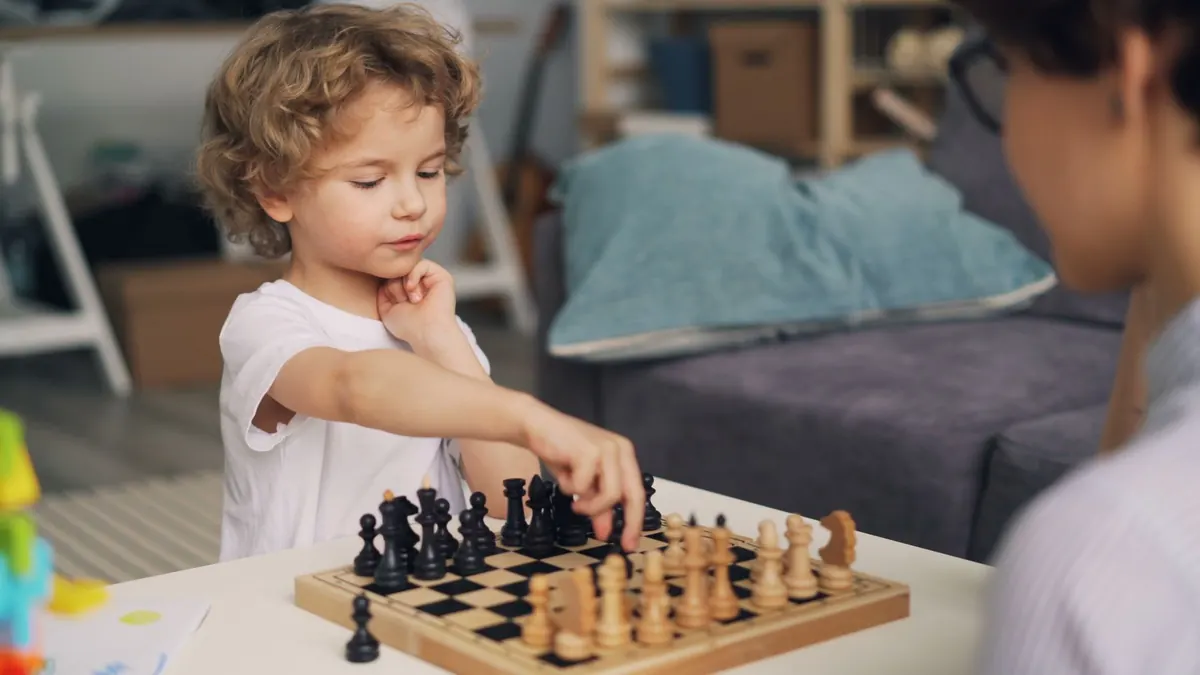
Photo: Vitaly Gariev / Pexels
Related Articles